
An effective RFP for contract manufacturing forces every vendor to bid against the same scope, the same acceptance criteria, the same pricing format, and the same evaluation weights, so the quotes that come back are actually comparable. This article gives you a copyable RFP template and a weighted scorecard you can drop into your next procurement cycle. Before you send anything, set your evaluation weights and lock your specs. That order matters more than most buyers realize.
TL;DR:
- Clearly defined scope, technical requirements, and evaluation weights are essential to generate comparable vendor quotes and avoid mismatched proposals.
- Precise units, test methods, and sample requirements in specs prevent misinterpretation and ensure vendors can meet exact standards.
- Setting evaluation weights before proposal submissions and normalizing prices over a multi-year total cost of ownership ensure fair, audit-ready comparison of bids.
- Requiring itemized pricing, formal confidentiality agreements, and proof of certifications helps prevent hidden costs and protects intellectual property.
- Avoid vague scope, inconsistent formatting, and missing signature requirements to prevent early disqualification or unreviewable proposals.
Table of Contents
- What Sections Belong in an RFP for Contract Manufacturing?
- How Do You Write Scope and Specs That Vendors Can't Misread?
- Building a Weighted Scorecard That Survives an Audit
- What Pricing Details Should the RFP Require?
- What Quality Evidence Should You Demand From Every Bidder?
- What Mistakes Sink an RFP Before Vendors Even Respond?
- Confidentiality and IP Protection in the RFP
- Author Perspective: Procurement Lessons From Contract Chemical Manufacturing
- How SaraWest USA Simplifies the RFP Process
- Templates and Standards Worth Bookmarking
- Sources
What Sections Belong in an RFP for Contract Manufacturing?
A contract manufacturing RFP needs eight sections, and skipping any one of them is how buyers end up with three "quotes" that can't sit next to each other on a spreadsheet. This structure mirrors what equipment and automation procurement teams already use, adapted for formulation and chemical production work.
- Executive summary. State the product category, target volume, and why you're sourcing now.
- Scope and deliverables. Define exactly what the manufacturer produces, packages, and ships, batch by batch.
- Technical requirements. Attach drawings, bill of materials, test methods, and sample sizes. Vague specs here poison every downstream comparison.
- Commercial terms and pricing structure. Require a fixed line-item format, payment terms, and MOQ tiers.
- SLA and support. Response times for defects, changeover flexibility, and escalation contacts.
- Implementation plan and timeline. Pilot batch dates, scale-up milestones, and full production start.
- Vendor qualifications and references. Certifications, relevant industry experience, and client references you can actually call.
- Evaluation and submission instructions. Deadline, file format, required signatures, and any mandatory forms (NDA, insurance certificates, W-9 or equivalent).
Every attachment you require should be listed by name, not implied. If you need a Certificate of Analysis template, sample retention agreement, or signed confidentiality acknowledgment, say so on page one, not buried in an appendix vendors might skip.
How Do You Write Scope and Specs That Vendors Can't Misread?
Specs fail when they're written to describe a product instead of testing one. A vendor reading "pleasant citrus scent, moderate viscosity" can't quote you anything real. A vendor reading "viscosity 800 to 1,200 cP at 25°C via Brookfield RV, spindle 3" can.
- Define units and tolerances explicitly. Every measurement needs a number, a unit, and an acceptable range, not an adjective.
- Name the test method. "pH 6.5 to 7.5" means nothing without specifying which meter, calibration standard, and temperature.
- Set batch and sample requirements. State minimum pilot batch size and how many retention samples the vendor must hold.
- Require a sample plan and CoA template. Ask vendors to submit their proposed release criteria, not just accept yours blindly.
- Address alternates upfront. Tell vendors whether they may propose substitute raw materials, and require they flag any substitution in writing before quoting.
Pro Tip: Write one "vague" and one "precise" version of your toughest spec side by side before you send the RFP. If you can't write the precise version yourself, the vendor can't hit it either.
Building a Weighted Scorecard That Survives an Audit
Set your evaluation weights before a single proposal arrives, not after you've already formed a favorite. Publishing weights in advance is standard practice among manufacturing RFP frameworks, and it's the single habit that separates a defensible award decision from one that looks like it was decided over lunch.
- Assign category weights. A common split: technical fit 30%, quality evidence 25%, price/TCO 25%, capacity and lead time 15%, references 5%.
- Score each criterion 1 to 5. Write a one-line rubric for each score so two evaluators reach similar numbers independently.
- Normalize pricing before scoring it. Convert every quote into a 3 to 5 year total cost of ownership, not a per-unit sticker price.
- Total and rank. Multiply score by weight, sum by vendor, and rank. No adjusting after the fact.
- Document the rationale. Record why the winning vendor scored where it did. That paper trail is what protects you if a rejected bidder asks questions later.
Capability matrices and QMS scorecards like these are common enough that most manufacturing RFP template libraries now build them in by default.
What Pricing Details Should the RFP Require?
Pricing chaos is the fastest way to sink an otherwise solid RFP. Vendors will bundle, hide, or omit line items unless you force a fixed format.
- Require itemized pricing: unit cost, tooling or setup fees, freight, minimum order surcharges, and any packaging or labeling charges as separate lines.
- Normalize to a 3 to 5 year TCO. A 5-year normalization is standard for capital-sensitive procurements; a shorter window works fine for consumable formulations with faster product cycles.
- Watch for the two most common traps: quotes that exclude freight, and MOQ tiers that quietly shift the effective unit price.
- Specify payment terms, SLA credits for late shipments, and warranty language as required fields, not optional notes.
- Separate technical and commercial envelopes. Evaluators score capability first, then open pricing, so quality doesn't get judged through a price lens. BidPacto's guidance on separating pricing assumptions and exclusions from the technical narrative applies directly here.
What Quality Evidence Should You Demand From Every Bidder?
Ask for documents that prove a claim, not statements that assert one. A vendor who writes "ISO certified" in a proposal means nothing until you've seen the certificate and its scope.
- Request ISO 9001 certification as the baseline QMS proof, with ISO 13485 or IATF 16949 layered on for medical or automotive applications, and FDA registration where the product category requires it.
- Ask for a recent audit summary, a representative batch record, and one CAPA example. Requiring representative batch records and audit summaries lets evaluators validate claims without scheduling a site visit first.
- Reserve the right to a third-party inspection or factory visit before award on any contract above a set dollar threshold.
- Require the vendor's proposed CoA template and sample release criteria as an attachment, not a promise.
Pro Tip: A vendor's supplier audit checklist is worth reviewing before you finalize your own quality section. Most gaps show up in what buyers forgot to ask for, not what vendors forgot to disclose.
What Mistakes Sink an RFP Before Vendors Even Respond?
- Vague scope. If two engineers on your own team read the spec differently, three vendors will quote three different products.
- No published weights. Scoring after the fact invites bias and can't survive a challenge from a rejected bidder.
- Mixed pricing formats. Letting vendors choose their own pricing layout guarantees you'll spend hours normalizing spreadsheets by hand.
- Missing signature or format requirements. Proposals arriving in five different file formats slow every reviewer down.
Watch for red flags once responses land: capacity claims with no supporting production data, QMS claims with no certificate attached, and pricing that bundles setup fees into "the unit cost" to look cheaper than it is.
Pro Tip: Before you issue the RFP, run a pilot-batch clause requiring retention samples from the winning vendor's first production run. It's the cheapest insurance you'll ever buy against a scale-up surprise.
Confidentiality and IP Protection in the RFP
Contract manufacturing RFPs routinely expose formulas, drawings, and production volumes to outside companies before a contract exists, so the confidentiality language belongs in the RFP itself, not just in a follow-on agreement. State plainly that any technical data, formulation detail, or drawing shared in the RFP is confidential and may only be used to prepare a response, not for any other business purpose.
Require every recipient to sign a mutual non-disclosure agreement before receiving detailed specs, and attach that NDA as a mandatory form rather than assuming vendors will ask for one. Spell out what happens to shared samples and prototypes: whether they must be returned, destroyed, or retained under confidentiality after evaluation ends.
Address intellectual property ownership directly, especially for any RFP that asks vendors to propose formulation changes or process improvements. State upfront whether IP developed during the RFP process, including any reformulation suggestions submitted by a bidder, belongs to your company or remains the vendor's. Silence on this point is how ownership disputes start after a vendor invests real R&D time into a proposal that doesn't win.
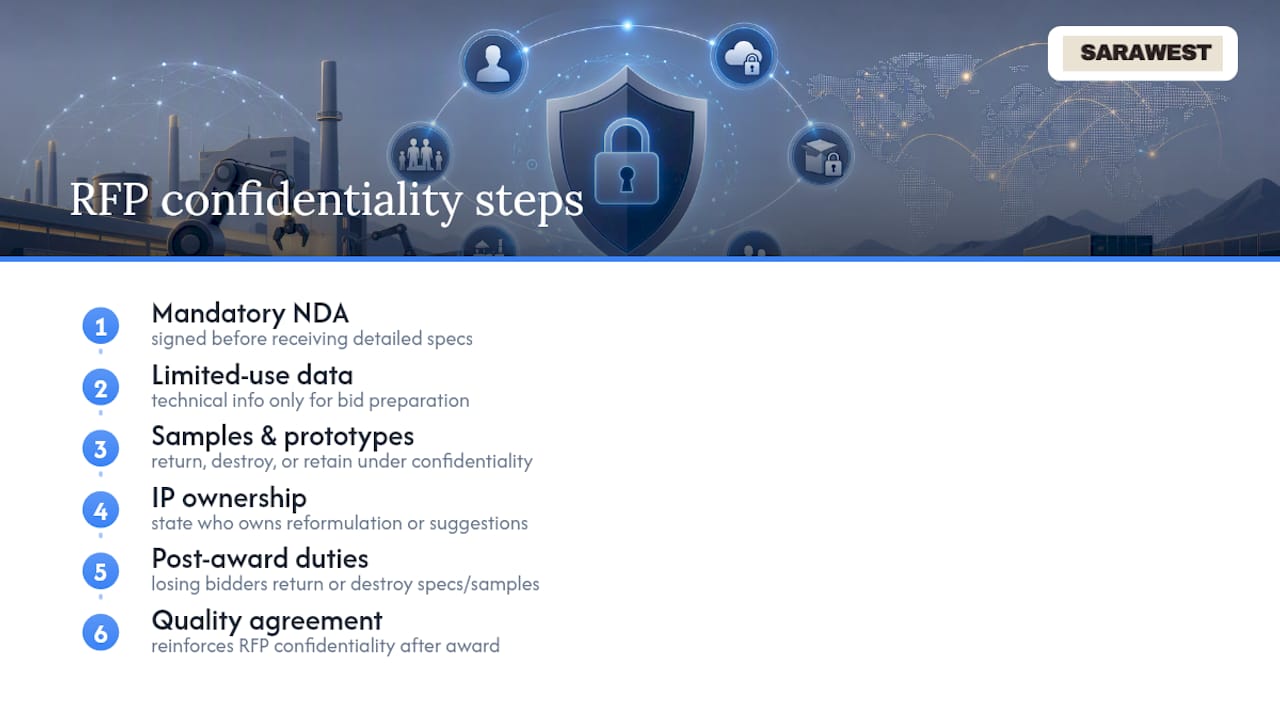
Add a clause covering what happens to competitive information after the award. Losing bidders should have a contractual obligation to destroy or return your specs, drawings, and any samples once the process closes. A quality agreement with the right clauses after award should reinforce, not replace, the confidentiality terms you set at the RFP stage. Getting this right at the RFP stage protects you long before contract negotiation begins.
Author Perspective: Procurement Lessons From Contract Chemical Manufacturing
Buyers who skip pilot runs pay for it during scale-up, when defects that a small batch would have caught show up across a full truckload. In-house formulation chemists cut iteration time because change orders route to the same team that wrote the original formula. Write acceptance criteria around what a pilot batch must prove before you commit to full production, and lean on a scale-up playbook rather than guessing at milestones.
— Faisal Mansur
How SaraWest USA Simplifies the RFP Process
Some contract manufacturers cut the RFP cycle from weeks of back-and-forth to a fast RFQ by enabling direct communication with in-house chemists who write the formulas instead of routing questions through a broker. With access to extensive proprietary formula libraries, pilot batches that scale to full truckloads, and rapid turnarounds on custom requests, some manufacturers can respond to technical questions quickly.
On request, Sarawest USA can furnish Certificates of Analysis, QMS documentation, sample kits, and relevant case studies so your evaluation team has real evidence to score against, not just proposal language. Some manufacturers build in flexibility for low pilot MOQs before a full commitment in their quoting process. Start by requesting a fast RFQ or ordering sample kits to attach directly to your evaluation packet.
Templates and Standards Worth Bookmarking
A few primary sources are worth keeping on hand while you build your own RFP:
- The DNDi CDMO RFP example shows how detailed work-package structures look for complex manufacturing contracts.
- BidPacto's manufacturing proposal template offers a vendor-side view of how strong proposals separate technical claims from pricing.
- ISO 9001 remains the reference standard for the QMS documentation you should request from every bidder.
- For machining or precision-component sourcing, this partner selection checklist covers criteria specific to that category.
Sources
- Manufacturing RFP Template for Equipment and Automation Vendor Selection | iFactory
- AI Manufacturing Proposal & Writing Guide | BidPacto
- ISO 9001 — Quality management systems