
Four solvent categories consistently deliver low odor without gutting performance: lactate esters, glycerin-derived solvents like Solvay's Augeo line, engineered bio-based synthetics, and select terpenes used with caveats. The choice between them comes down to one trade-off: odor intensity almost always trades against solvency strength, regulatory clearance, or supply stability. Before scaling any candidate, run objective odor-intensity testing alongside a full SDS and regulatory review. Skip that step and you're guessing, not formulating.
TL;DR:
- Low odor solvents like lactate esters and glycerin-derived options offer effective cleaning performance but often come with higher costs or supply constraints.
- Proper evaluation involves objective odor-intensity testing, solvency measurements, regulatory screening, and real production pilot runs to ensure stability and safety.
- Terpenes provide high solvency but have supply volatility and carry distinctive scents that may impact formulation compatibility.
- Glycerin-based solvents are reliable substitutes for glycol ethers, delivering strong solvency with lower odor and better environmental profiles, though they may still face cost considerations.
- A 1,000-unit pilot run helps identify odor drift and manufacturing issues early, reducing risks before full-scale production.
Table of Contents
- What Are the Best Low Odor Solvent Alternatives for Cleaning Products?
- How Do You Evaluate a Low Odor Solvent Candidate?
- Trade-Offs and Performance by Solvent Class
- Formulation and Prototyping Checklist Before You Scale
- Supply Chain, Cost, and Availability Considerations
- Why "Low Odor" Needs an Objective Test, Not a Sniff
- Environmental Impact and Biodegradability of Low Odor Solvents
- Will a Low Odor Solvent Play Nice With Your Other Ingredients?
- Real Substitution Wins in Cleaning Formulations
- What Sara West USA Sees Working in Real Pilot Runs
- Ready to Prototype Your Low Odor Formula?
- Sources
- FAQ
What Are the Best Low Odor Solvent Alternatives for Cleaning Products?
Formulators chasing low odor solvent alternatives usually land on five workable categories. Each one solves a different piece of the puzzle, and none of them is a universal swap for traditional glycol ethers or mineral spirits.
- Butyl lactate and other lactate esters carry a mild, low odor profile while holding solvency for resins, adhesives, and greasy soils. They're biodegradable and maintain film behavior comparable to harsher petrochemical solvents.
- Glycerin-derived solvents, including Solvay's Augeo line, combine low odor with high solvency and a bio-based origin, making them a strong fit where buyers demand a sustainability claim.
- Engineered green solvents are built to be multifunctional and biodegradable, cutting VOCs while reducing environmental impact without sacrificing cleaning power.
- Terpenes like d-limonene and dipentene deliver serious solvency, but they arrive with a distinct citrus or pine scent and supply volatility tied to citrus harvests.
- Aliphatic hydrocarbons, or mineral spirits, still offer predictable bulk economics, but they come with odor and VOC baggage that many low-odor programs are specifically trying to escape.
None of these is "low odor" in an absolute sense. They're low odor relative to the traditional glycol ethers and heavy aromatic solvents they're replacing, and that distinction matters when you're setting internal specs.
How Do You Evaluate a Low Odor Solvent Candidate?
A candidate solvent earns its place in your formulation only after it clears five checkpoints, in this order.
- Build a simple odor panel. Have three to five trained noses score intensity and persistence at multiple time points, not just at first sniff. Odor fade rate matters as much as initial strength.
- Pull the solvency data. Get the Kauri butanol (KB) value, evaporation rate, and flash point from the supplier or your own lab. These numbers tell you how the solvent will actually behave against grease, wax, or resin soils.
- Screen the SDS. Check inhalation toxicity language, VOC content, Prop 65 listings, and any TSCA flags before you invest bench time.
- Run material compatibility trials. Test the solvent against your actual packaging, gaskets, and any surfactants or fragrance oils in the formula.
- Plan a pilot run. Confirm odor stability over shelf life and verify your workplace controls hold up at production scale, not just at bench scale.
Pro Tip: Don't let a pleasant citrus or pine note lull you into skipping the inhalation review. A mild scent can mask real exposure risk, so treat "smells fine" and "tests fine" as two completely separate questions.
Trade-Offs and Performance by Solvent Class
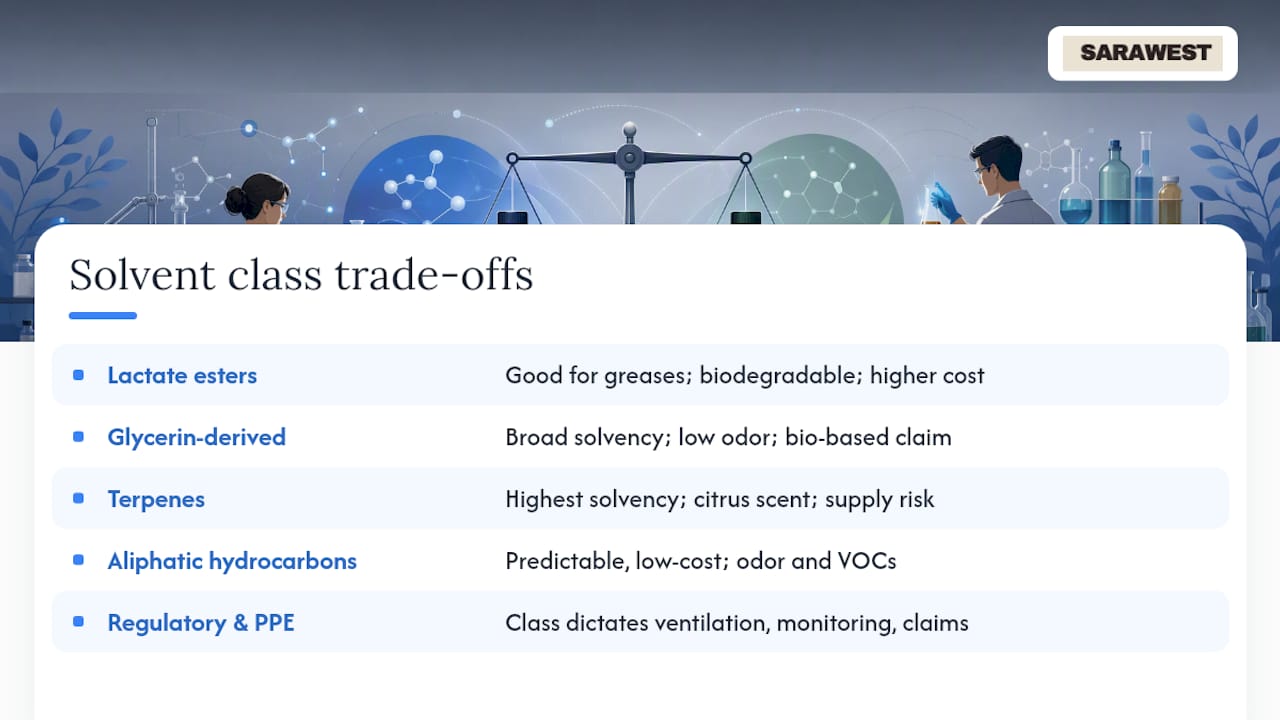
Lactate esters shine on resin-heavy and greasy soils, and their biodegradability supports clean-label claims without a major solvency penalty. Their limitation is cost. They typically run higher than commodity hydrocarbons, so they fit best in premium or specialty SKUs rather than high-volume commodity lines.
Glycerin-derived solvents like Augeo-style molecules deliver strong solvency across a wider range of soils, including some tough industrial residues. Prefer them when you need both low odor and a bio-based claim on the label, since they check both boxes at once rather than forcing a compromise.
Terpenes remain the highest-solvency option on this list for many oil and grease applications, but that solvency comes bundled with a recognizable scent and a supply chain tied to citrus agriculture cycles. Price swings tend to follow harvest volume, which makes long-term contracts riskier than they look on paper.
Aliphatic hydrocarbons, or mineral spirits, still win on predictability. Supply is steady, pricing is transparent, and performance is well documented. The trade-off is obvious: odor and VOC content that work against most low-odor and environmental positioning goals.
Class choice also dictates your PPE and monitoring requirements. A terpene-heavy formulation may need different ventilation controls than a lactate ester system, even if both test as "low odor" on a sensory panel. Your label claims follow the same logic: a biodegradable, low-VOC claim only holds up if the solvent class backing it can actually support that language under scrutiny, not just under a sniff test.
Formulation and Prototyping Checklist Before You Scale
Moving a low-odor candidate from bench to production floor works best as a fixed sequence, not an improvised process.
- Set your targets first. Define the maximum acceptable odor intensity score and the minimum KB value or evaporation rate the finished product needs before you touch a beaker.
- Run bench trials. Record odor-intensity scores alongside solvency performance at every iteration, not just at the final formula.
- Complete regulatory screens. Confirm VOC content, check Prop 65 status, and flag any inhalation warnings on the SDS before committing lab hours to scale-up work.
- Validate with a pilot run. A 1,000-unit pilot will surface manufacturing quirks and odor drift that bench testing simply can't catch.
- Lock procurement and packaging. Finalize supplier agreements and shipping classifications only after the pilot results confirm the formula holds up.
Skipping the pilot step is where most low-odor transitions quietly fail. A solvent that tests clean on the bench can still drift in odor after weeks in a sealed bottle, and you won't know that until you've run real units through real packaging.
Supply Chain, Cost, and Availability Considerations
Terpene-based solvents carry the most price risk on this list. Because d-limonene is an agricultural by-product, pricing tracks citrus harvest volume, and a bad season can double your cost overnight. Multi-sourcing across suppliers helps, but it doesn't eliminate the exposure.
Engineered bio-based synthetics generally offer steadier pricing and supply, since they aren't tied to a single crop cycle. Packaging and shipping add their own constraints: many low-odor solvents are still flammable, which triggers limited-quantity shipping rules that affect both cost and lead time. Build your inventory forecast around pilot-scale needs first, then layer in mass-production volume once the formula is locked.
Why "Low Odor" Needs an Objective Test, Not a Sniff
"Low odor" is a marketing phrase until you attach a number to it. Two solvents can both smell faint to a formulator's nose while differing sharply in how consumers or workers perceive them over an eight-hour shift. That gap is why odor characterization needs its own measurement track, separate from VOC content or KB value.
Gas chromatography-olfactometry (GC-O) lets you pair chemical composition with human-perceived odor intensity at each compound peak, which is the closest thing the industry has to an objective odor fingerprint. Trained sensory panels back that up with real-world perception data, scoring both initial intensity and how long the scent lingers on a surface or in a room.
This distinction matters because odor intensity and evaporation rate don't move together. A fast-evaporating solvent can still leave a lingering trace compound behind, and a slow-evaporating one might smell strong at first application but fade quickly. Formulators who test only for VOC percentage, assuming it maps directly to perceived odor, get blindsided during consumer panels. Build odor-intensity testing as its own line item in your development process, scored independently from solvency and evaporation metrics, and you'll catch these mismatches before a customer does.
Environmental Impact and Biodegradability of Low Odor Solvents
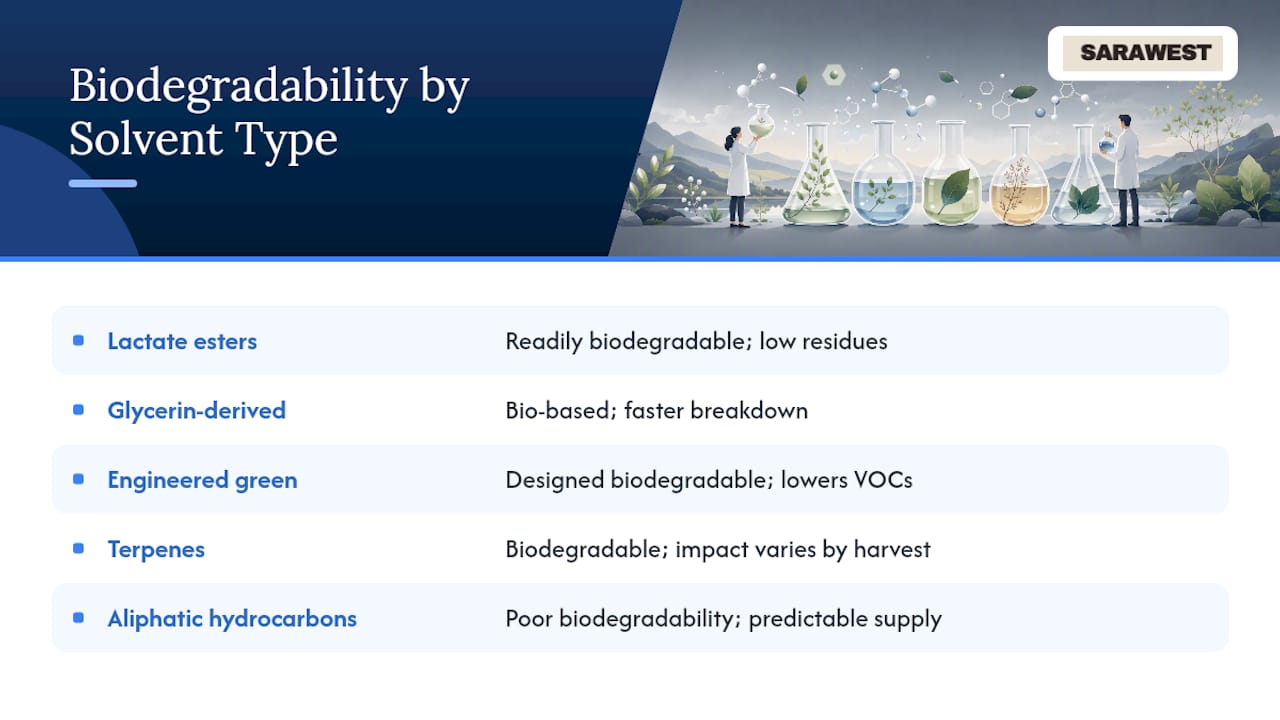
Biodegradability and low odor tend to travel together, but not automatically. Lactate esters break down readily and maintain solvency performance without leaving persistent residues, which is why they show up in coatings and cleaning formulations aiming for both claims at once. Glycerin-derived solvents follow a similar path, since their bio-based origin generally supports faster environmental breakdown than petrochemical alternatives.
Engineered green solvents are often designed specifically for this dual purpose. Review literature on green solvent adoption points to a clear industry shift toward multifunctional, biodegradable molecules that reduce VOC output while improving overall environmental safety profiles. That combination is increasingly what buyers expect on a spec sheet, not just what regulators require.
Terpenes complicate the picture. They're naturally derived and biodegradable, but their agricultural origin means environmental impact scales with harvest practices rather than a controlled manufacturing process. Aliphatic hydrocarbons sit at the other end of the spectrum. They're predictable in supply and performance, but they carry the weakest biodegradability profile of the group, and that's the exact trade-off pushing many formulators toward lactate esters and engineered synthetics in the first place.
Will a Low Odor Solvent Play Nice With Your Other Ingredients?
Swapping solvents rarely happens in isolation. Surfactants, fragrance oils, and preservative systems all react differently depending on what carrier solvent is doing the work around them, and that interaction can quietly undo months of formulation progress if it's not tested directly.
Fragrance stability is the most common failure point. A citrus-scented terpene solvent can clash with or mask an intentional fragrance oil blend, throwing off the scent profile a brand spent months developing. Lactate esters and glycerin-derived solvents tend to be more neutral partners here, which is part of why they pair well with a dedicated scent matching service trying to hit a precise fragrance target.
Preservative systems deserve their own compatibility pass. Some low-odor solvents shift the pH or water activity of a formula just enough to reduce a preservative's effectiveness, which shows up as stability failure months later, not on day one. The same caution applies to biodegradable surfactant systems, where solvent polarity affects how well the surfactant disperses and performs over shelf life. Run accelerated stability testing, at minimum 30, 60, and 90 days at elevated temperature, before you trust a new solvent and surfactant pairing at scale.
Real Substitution Wins in Cleaning Formulations
The clearest substitution pattern in cleaning formulations right now is glycol ether replacement. As certain glycol ethers face elimination or restriction under TSCA, formulators are moving toward lactate esters and glycerin-derived solvents in glass cleaners, degreasers, and all-purpose formulas that once relied on traditional glycol ether chemistry.
Glass and surface cleaners show this shift plainly. A formula built around a glycerin-derived solvent can hold streak-free performance while dropping both VOC content and perceived odor, which is exactly the combination retail buyers now ask for on spec sheets. Antistatic and sanitizing formulations tell a similar story: swapping a harsh aromatic solvent for a lactate ester often preserves cleaning speed while cutting the sharp chemical smell that used to trigger customer complaints in enclosed commercial spaces.
The pattern that keeps repeating across successful substitutions is this: teams that tested odor intensity as a standalone metric, separate from VOC and solvency data, caught problems before launch. Teams that treated "low odor" as a marketing checkbox instead of a measurable spec tended to discover the gap only after a customer complaint or a failed retail audit.
What Sara West USA Sees Working in Real Pilot Runs
We've watched formulators lose months chasing a low-odor solvent on paper that falls apart in real production. In-house R&D chemists build and test candidates on-site, so odor and solvency data can be generated in the same facility rather than relying solely on supplier data sheets. A 1,000-unit pilot run on an odor-eliminator product cut manufacturing risk by surfacing shelf-life odor drift before full-scale production, exactly the failure point that sinks most low-odor transitions. Flexible batch sizes mean you test small, learn fast, and scale only once the data backs you up.
— Faisal Mansur
Ready to Prototype Your Low Odor Formula?
Sarawest USA turns a solvent shortlist into a working formula faster than the trial-and-error cycle most manufacturers default to, because our in-house R&D chemists run bench trials, SDS screening, and pilot validation under one roof instead of bouncing your project between three separate vendors.
That matters most at the pilot stage, where odor drift and material compatibility problems actually surface. Our 1,000-unit pilot runs give you real production data before you commit to a full truckload order, and our proprietary library of over 1,200 formulas means we may already have a low-odor base close to your target, cutting weeks off development. Whether you need a custom formulation, a white-label solution, or straight contract manufacturing support, our team handles the chemistry so you don't have to guess your way to a launch date. Get a fast RFQ started and find out how quickly your low-odor candidate can go from bench to pilot batch.
Sources
For deeper technical review, consult the EPA's TSCA glycol ether guidance, lactate ester performance data, and supplier technical pages for solvent-specific SDS and property sheets.
- Low Odor, High Performance: Butyl Lactate in Coatings Applications - BIVITURE
- Green analytical approaches and eco-friendly solvents — Orient Journal of Chemistry (review)
- Augeo®: An Innovative Line of Natural Solvents | Solvay
- Why is D-Limonene a Good Solvent? | Vertec BioSolvents
FAQ
What Makes a Solvent "Low Odor" in a Regulatory Sense?
There's no single regulatory threshold for "low odor." It's a functional term formulators define through sensory panel scores and odor-intensity testing, not a fixed number set by the EPA or OSHA.
Are Terpene Solvents Like D-Limonene a Safe Low Odor Choice?
Terpenes offer strong solvency but carry a distinct citrus scent and price volatility tied to citrus harvests, and their pleasant smell should never substitute for a full inhalation toxicity review.
How Many Units Should a Pilot Run Include Before Scaling?
A 1,000-unit pilot run is generally enough to surface odor stability issues and manufacturing quirks before committing to full-scale, truckload-size production.
Can Glycerin-Derived Solvents Replace Traditional Glycol Ethers?
Yes, in many cleaning applications. Glycerin-derived solvents like Solvay's Augeo line match or exceed the solvency of traditional glycol ethers while cutting odor and supporting a bio-based label claim.
Does Low VOC Automatically Mean Low Perceived Odor?
No. VOC content and perceived odor intensity are separate measurements, and a low-VOC solvent can still register as strong-smelling on a trained sensory panel if odor-intensity testing isn't run independently.