
Rely on both real time and validated accelerated stability testing, not one or the other. Accelerated data can predict an interim shelf life fast, but only real time confirmation on the shelf, in the actual package, holds up as a defensible label claim. What follows is a practical protocol covering test methods, the parameters to track, sampling design, packaging checks, how to read the data, and what the whole program tends to cost.
TL;DR:
- Validated real-time testing in the actual package is essential for a defensible label claim, even when accelerated data predicts interim shelf life.
- Manufacturers typically apply a safety margin below experimental data, accounting for distribution variability, warehouse heat fluctuations, and lot-to-lot differences.
- At least four real-time data points, including the initial and a three-month check, are necessary before relying on acceleration extrapolation.
- Testing should include chemical, physical, and performance parameters, as well as package compatibility checks like permeability, stress cracking, and closure integrity.
- Building a simple protocol with three lots and scheduled pulls at 0, 3, 6, and 12 months is sufficient for starting stability testing.
Table of Contents
- What Shelf Life Testing for Cleaners Actually Means
- Real Time vs. Accelerated Stability Testing: Which Rules Apply
- Which Tests Should You Run on a Cleaning Formula
- How to Design a Study That Holds Up Under Scrutiny
- Testing the Package, Not Just the Formula
- Reading the Data and Setting a Defensible Label Date
- What a Stability Program Actually Costs and Takes
- Where Sarawest USA Fits Into a Stability Program
- What I'd Actually Tell a QA Team Starting From Zero
- Need Pilot Batches Before You Start Testing?
- Sources
What Shelf Life Testing for Cleaners Actually Means
Shelf life is the point at which a formula stops performing the way the label promises. That is a different question than "when does it expire on paper." Functional shelf life is the actual date a surfactant blend loses cleaning power, a pH buffer drifts out of range, or a preservative system stops holding back microbial growth. Label expiration is the number you print, and it should sit below that functional date, not equal to it.
The EPA's OPPTS 830.6317 storage stability guideline sets the regulatory frame most formulators work within. It calls for testing in the actual commercial package, checking active concentration at the start and then every three months for at least a year, and documenting any extrapolation method used to project beyond the tested period.
Most manufacturers build in a margin below what the data supports:
- Conservative labeling typically shaves a significant percentage off the experimentally supported shelf life to cover distribution variability, per University of Idaho stability guidance.
- That buffer absorbs warehouse heat spikes, delayed retail turnover, and lot-to-lot variation you can't fully predict at the lab bench.
- A tighter buffer might be defensible for a fast-moving SKU with reliable cold-chain distribution, but most general cleaners don't get that luxury.
Real Time vs. Accelerated Stability Testing: Which Rules Apply
Real time testing is the baseline. You store product at label conditions, typically room temperature, and pull samples on a fixed schedule until the formula fails or you reach your target shelf life. It's slow, but it's the only method that produces data a regulator or a retail buyer can't argue with.
Accelerated testing solves the speed problem. Storing product at elevated temperatures, commonly +10°C to +15°C above ambient, for a period of 3 to 9 months, lets you project a shelf life of up to roughly three years using an established extrapolation model, according to BioPharm International's overview of stability testing. Neither temperature range nor extrapolation model is universal. Every formula needs its own validation before you trust the projection.
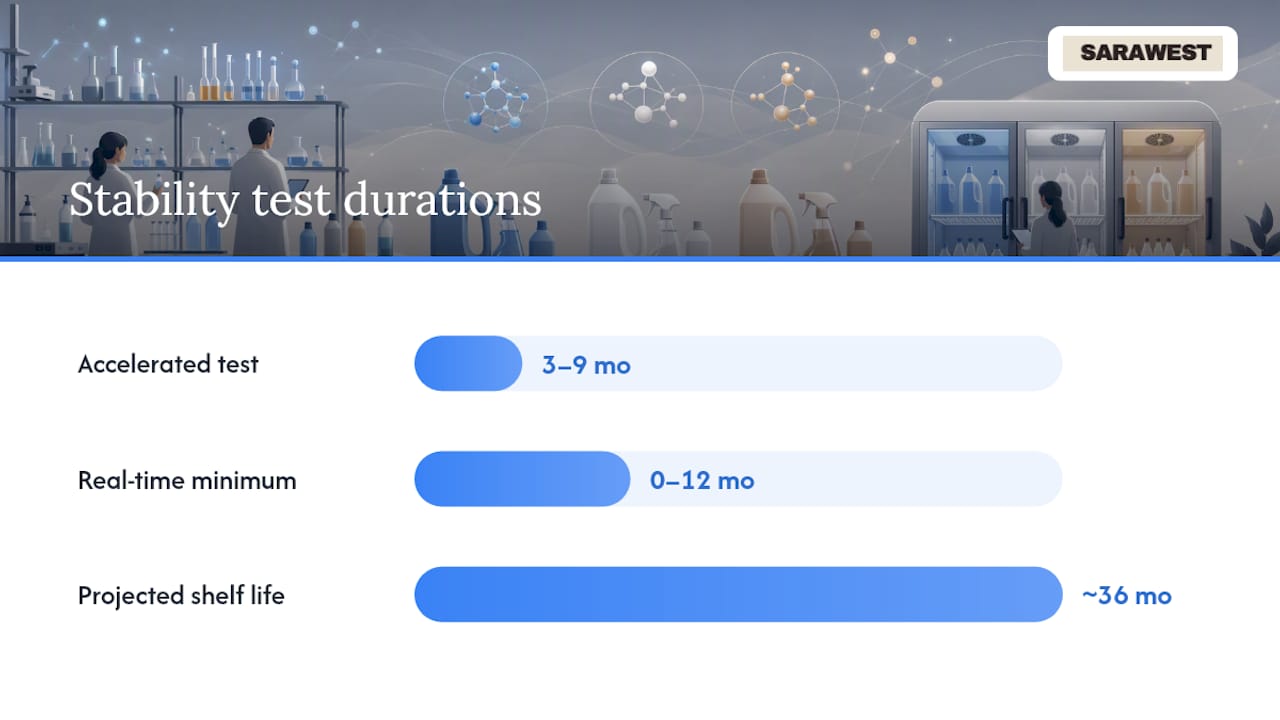
Statistic to know: at least four real time data points, including the initial reading and a three month pull, are recommended before you lean on an accelerated extrapolation for label purposes.
A workable protocol looks like this:
- Start real time and accelerated arms simultaneously, using the same production lot for both.
- Pull real time samples at 0, 3, 6, 9, and 12 months minimum, extending further for long-shelf-life claims.
- Run the accelerated arm at a validated elevated temperature and confirm the predicted failure point against early real time data before the label goes final.
- Treat the worst-performing batch, not the average, as your shelf life ceiling until you have enough lots to justify otherwise.
Our guide to accelerated aging methods walks through temperature mapping in more detail if you're building this protocol from scratch.
Which Tests Should You Run on a Cleaning Formula
A cleaner degrades in more ways than a casual glance at the bottle will reveal. Chemical assays catch what your eyes miss, and physical checks catch what the assay misses in turn.
On the chemistry side, run active ingredient assays using HPLC, GC, or titration depending on the actives involved, and track impurity formation alongside the parent compound. A surfactant that degrades into a byproduct can quietly wreck detergency long before the label concentration drops enough to flag on its own.
Physical parameters round out the picture:
- pH, checked against the formula's stability window, not just a generic "safe" range.
- Viscosity, since thickener systems can thin out or gel unpredictably with age.
- Specific gravity, appearance, and odor, tracked against a retained control sample.
- Phase separation, which often shows up before any single chemical assay flags trouble.
Detergency and performance testing belong on the list too. A cleaner that passes every chemical assay but stops cutting grease has still failed its shelf life. For water-based formulas or anything prone to user contamination, preservative efficacy and microbial challenge testing matter just as much as chemistry. Our microbial challenge testing guide covers the protocol most labs use for that piece.
How to Design a Study That Holds Up Under Scrutiny
Lot selection is where a lot of programs quietly fail before they even start. Testing a single production lot and calling the result your shelf life is a common shortcut, and it's the fastest way to get a label claim challenged later.
- Use at least three production lots, ideally spanning normal raw material variability.
- Base your labeled shelf life on the least stable lot tested, not the average across lots, unless you can document why an outlier is unrepresentative.
- Build a back-loaded pull schedule, weighting sample points toward the expected end of life rather than spacing them evenly. A cleaner expected to last 24 months might pull at 0, 3, 6, 12, 18, 21, and 24 months, concentrating scrutiny where failure is most likely.
- Run enough replicates per pull point, and size your sample count to reach 90 to 95% confidence in the result, per the University of Idaho's experimental design guidance.
- Write your acceptance criteria before you collect a single data point, not after you see how the numbers look.
Pro Tip: Lock your acceptance criteria and pass/fail thresholds into the protocol document before testing starts. Deciding what "still acceptable" means after you've seen the data is how QA teams talk themselves into a shelf life the formula doesn't actually support.
Testing the Package, Not Just the Formula
A stability program that ignores the bottle is only half a program. Cleaners fail in the field because the container let them down just as often as the chemistry did, and that failure mode almost never shows up if you're testing bulk product in a lab beaker instead of the real commercial package.
Run these checks in the actual container you plan to ship:
- Permeability testing, since some plastics let volatile actives migrate out slowly over months.
- Stress cracking assessment, particularly for bottles holding high-pH or solvent-heavy formulas.
- Closure integrity and torque retention, checked at each pull point alongside the chemistry.
- Headspace and fill weight monitoring to catch slow leakage before it shows up as a customer complaint.
Packaging interactions tend to surface before bulk chemistry visibly degrades, which is exactly why the OPPTS 830.6317 guideline requires testing in commercial packaging rather than generic lab containers. Our packaging compatibility testing guide breaks down the full checklist if you're setting this up for the first time.
Reading the Data and Setting a Defensible Label Date
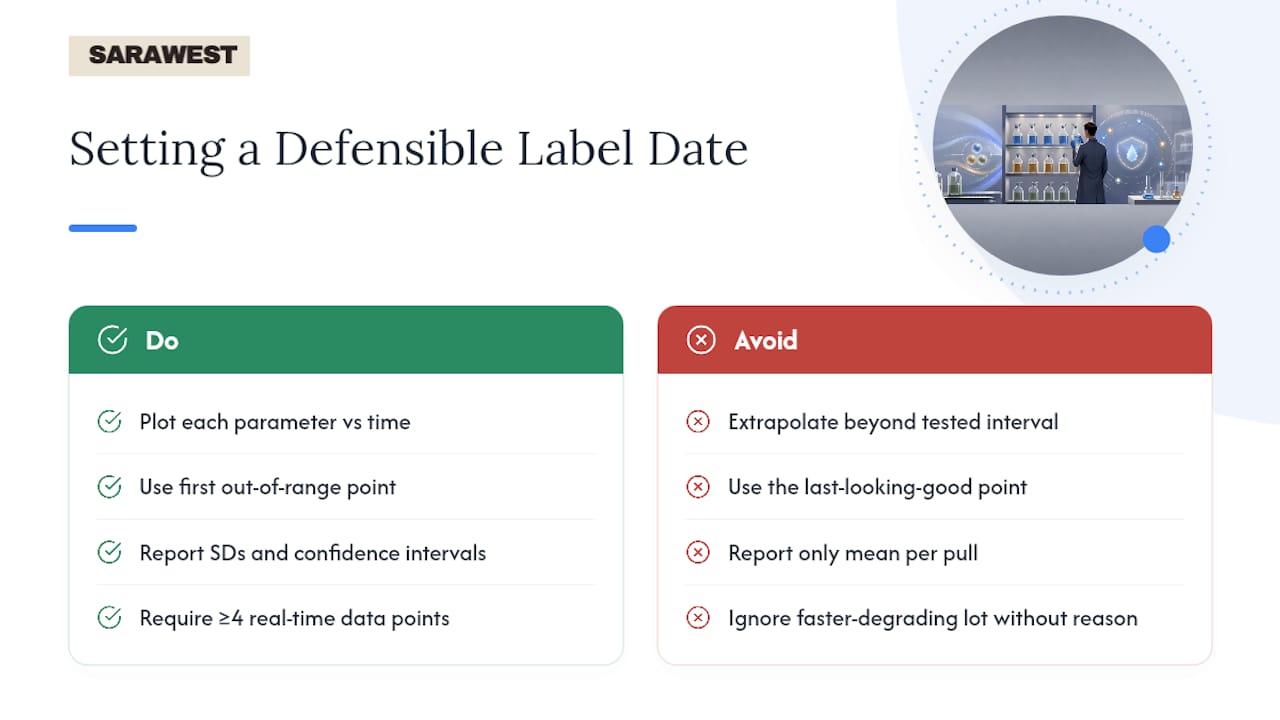
Plot each tracked parameter against time and look for the first point where any single measurement drops out of your predefined acceptance range. That point, not the last one that happened to look fine, is your true shelf life.
Extrapolation beyond your longest tested real time interval is where most defensible programs draw a hard line. A linear trend that holds for 12 months of real data doesn't guarantee it holds at 24, and regulators reviewing disinfectant or pesticidal product filings will ask for the real time data to back any projection past the tested range.
Report standard deviations and confidence intervals alongside the raw numbers, not just a single mean value per pull point. If your worst-performing lot degrades faster than the other two, document why, and set the label based on that lot unless you have a documented reason to treat it as an anomaly.
Key figure: the BioPharm International guidance recommends at least four real time data points before extrapolated claims go on a label. Fewer than that, and you're guessing dressed up as data.
What a Stability Program Actually Costs and Takes
Cost scales almost entirely with how much testing complexity you build into the protocol. More pull points, more lots, and more sophisticated analytics all add up fast.
- Analytic method matters most: HPLC assays cost meaningfully more per sample than a pH or viscosity check, according to Michigan State University Extension's breakdown of stability testing costs.
- Microbiology testing, when your formula needs it, adds both cost and turnaround time.
- Running duplicate or triplicate containers at every pull point multiplies lab fees quickly, so decide replicate counts with cost in mind, not just statistical ideal.
Timelines split roughly two ways. An accelerated-only program can produce usable interim data in 3 to 6 months. Full real time confirmation, the kind that actually supports a label without caveats, typically runs 12 to 18 months. Get quotes from at least two accredited labs before committing, since protocol complexity swings pricing more than lab reputation does.
Where Sarawest USA Fits Into a Stability Program
Getting pilot batches into testing fast is often the bottleneck, not the lab work itself. Sarawest USA's in-house R&D chemists work from a library of more than 1,200 proprietary formulas, which means adapting an existing cleaner or building a new one for your stability protocol doesn't require starting from a blank page.
That matters most when you need pilot lots quickly, retained samples for later comparison, or several formulation variants running in parallel before you commit to a full real time program. Our case studies show that kind of pilot-to-scale work in practice. Reach for a contract manufacturer at this stage; save the accredited analytical lab for the assays themselves.
What I'd Actually Tell a QA Team Starting From Zero
If you're building your first program, don't overthink the minimum viable design: three lots, pulls at 0, 3, 6, and 12 months, core assays plus packaging checks at each point. That's defensible and affordable.
The mistakes I see most: one lot treated as representative, packaging left out entirely, and raw material substitutions that never trigger re-testing. Draft the protocol, get two lab quotes, and schedule a pilot run before you lock anything into a label.
— Faisal Mansur
Deciding what "still acceptable" means after you've seen the data is how QA teams talk themselves into a shelf life the formula doesn't actually support; for a practical guide on establishing robust acceptance criteria, see this manufacturing quality assurance checklist for pros.
Need Pilot Batches Before You Start Testing?
Some contract manufacturers can provide a testable pilot lot faster than building a formula from scratch and shopping it to a lab cold. Experienced contract manufacturers often adapt existing formulas to client specifications or build new ones, and may achieve rapid pilot quantity production turnaround.
That speed matters most in the early stages of a stability program, when you need multiple formulation variants running in parallel before you commit to a 12 to 18 month real time study. Whether you need a small pilot batch for accelerated testing or you're scaling toward a full production run, our contract manufacturing services cover both ends. Start by requesting product samples from our formula library, or send us your specifications for a formulation quote.
Sources
- Assessing shelf life using real‑time and accelerated stability tests — BioPharm International
- Product Properties Test Guidelines OPPTS 830.6317 — EPA
- Shelf‑life experimental design and interpretation — University of Idaho content hub
- Understanding shelf‑life testing for packaged products — Michigan State University Extension